
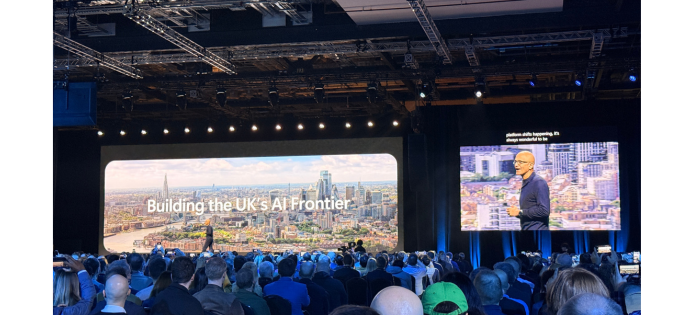
Artificial intelligence is moving quickly. Anyone working with Microsoft 365, Copilot and AI tools can see that the pace of development is accelerating.
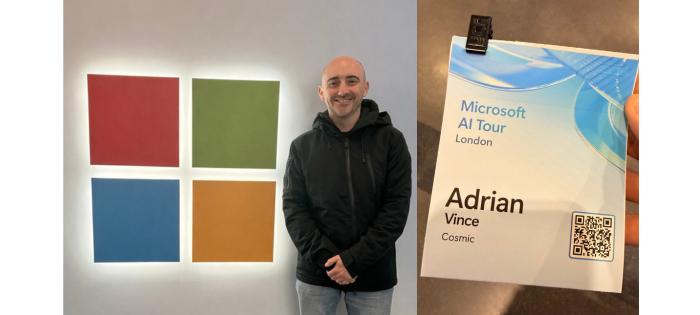
At Microsoft AI Live in London, Adrian Vince had the opportunity to hear directly from Microsoft about how they see the future of AI in the workplace, particularly how Microsoft Copilot and AI agents will integrate with everyday business tools.
The event offered a clear glimpse of where Microsoft AI technology is heading. Yet it also highlighted a familiar challenge for many organisations. The tools are advancing rapidly, but many teams are still figuring out how to use AI within Microsoft 365 confidently in day-to-day work.
The big signals from Microsoft AI Live
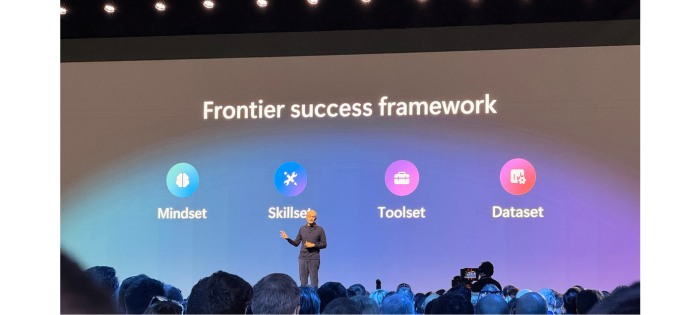
One of the most useful frameworks shared during the event was Microsoft’s Frontier Success Framework, which outlines four foundations for successful AI adoption in organisations.
Mindset
Adopting AI starts with the right mindset. Teams need curiosity and a willingness to experiment with tools such as Microsoft Copilot, while also recognising that AI still requires human judgement.
Skillset
Skills matter. Effective use of AI tools in Microsoft 365 depends on developing practical abilities that transfer across different tools and tasks. Prompting, evaluating outputs, and understanding limitations all fall within this skill set.
Toolset
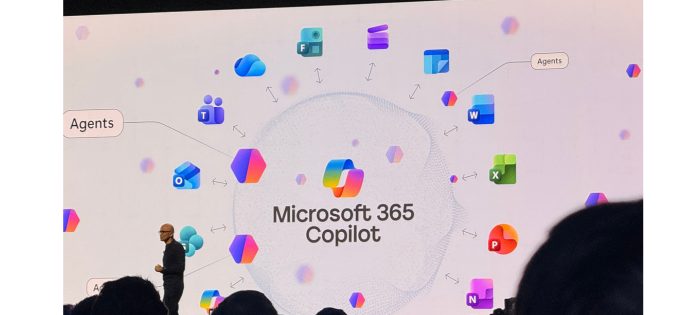
Choosing the right tool for the right task is essential. Microsoft’s direction is clear. AI capabilities will increasingly sit inside familiar Microsoft 365 applications such as Word, Excel, Outlook and Teams.
Dataset
AI amplifies whatever information it receives. Organisations, therefore, need to understand their data and governance practices. Clean data, clear permissions and strong AI data governance are becoming central to responsible AI use.
This framework reflects a wider shift. AI success is not simply about access to technology. It depends on skills, context and informed decision-making.
For organisations already working within the Microsoft 365 ecosystem, this approach makes sense. AI is increasingly embedded within existing workflows rather than requiring entirely new systems.
Microsoft’s direction for AI in Microsoft 365
365
Several themes emerged strongly throughout the event.
First, Microsoft is clearly positioning Copilot as a central productivity layer across Microsoft 365. Rather than launching separate AI products, the company is weaving AI into the tools people already use every day.
Second, security and data governance are now core parts of the AI conversation. Organisations want reassurance that their information remains secure when AI is involved. Microsoft is responding by building stronger controls and governance into the platform.
Third, Microsoft continues to emphasise that AI should reduce friction rather than create it. The goal is for AI to support everyday work tasks such as summarising meetings, analysing documents, drafting content or organising information.
The intention is simple. AI should work alongside people, inside familiar tools.
Where does the real gap still sit?
Despite the impressive technology on display, one theme stood out throughout the day.
The gap between what AI tools can technically do and how ready most organisations are to use them confidently.
Training examples often fell into two categories. Either very basic demonstrations of features inside applications, or highly technical examples designed for developers.
Main stage demos showed tasks such as summarising documents, referencing meetings or generating text with Microsoft Copilot.
Those examples are useful. Yet many organisations leave these events with the same question.
What should we actually do with AI on Monday morning?
For small and medium organisations, charities and community groups, the challenge is rarely access to AI tools. Increasingly, those tools are already present within Microsoft 365 environments.
The challenge is confidence.
Many users still rely on demonstrations rather than understanding AI prompting as a transferable skill. Without that foundation, people can feel dependent on features rather than empowered to explore how AI might support their own work.
AI agents: exciting but still complex
Another major topic throughout Microsoft AI Live was the emergence of AI agents.
Agents represent the next stage of AI development. Instead of responding to prompts, agents can carry out sequences of actions, automate tasks and interact with systems.
Some of these possibilities are genuinely powerful. Over time, AI agents within Microsoft platforms could streamline processes, reduce administrative work and automate routine tasks.
At the same time, many of the examples shown involved complex technical design. For smaller organisations, building and managing these kinds of solutions would likely require specialist support.
There is still a significant middle ground between basic AI productivity tools and advanced AI automation. That middle ground is where many organisations currently sit.
What does this mean for organisations using AI today?
The potential productivity gains from AI in Microsoft 365 are real. Microsoft shared compelling evidence that tools such as Copilot can save time, reduce cognitive load and support decision-making.
Yet readiness varies widely.
Most organisations do not need to rush into advanced automation or complex AI agent systems. A more realistic starting point is building practical confidence.
That includes:
- Understanding where AI can genuinely support everyday work
- Developing transferable prompting skills
- Learning how to review and refine AI outputs
- Building awareness around AI governance and responsible use
AI adoption rarely succeeds through technology alone. It develops through skills, experimentation and practical understanding.
Why independent guidance still matters?
Events like Microsoft AI Live highlight an important point.
Technology vendors understandably focus on what their platforms can do. Organisations often need support translating those possibilities into practical steps.
For many businesses, charities and community organisations, the real need is simple.
Clarity.
At Cosmic, the focus is on helping organisations use AI and Microsoft 365 tools in ways that genuinely support their work. That means developing practical skills rather than relying on feature demonstrations.
It also means helping organisations understand what is useful now, what can wait and where AI can genuinely improve productivity.
AI technology will continue to evolve rapidly. Many organisations are moving more carefully.
That thoughtful pace is often the right one.
Real value comes from bridging the gap between capability and confidence.